Coordinated UAV swarms for disaster search & rescue
Natural disasters — earthquakes above all — strike Turkey more and more often.[1] When they do, searching the affected area quickly and reliably saves lives. A team of cooperating UAVs can sweep the ground far faster than responders on foot, stay connected to a ground control station (GCS), and improve detection reliability through redundancy and collaboration.[2, 3]
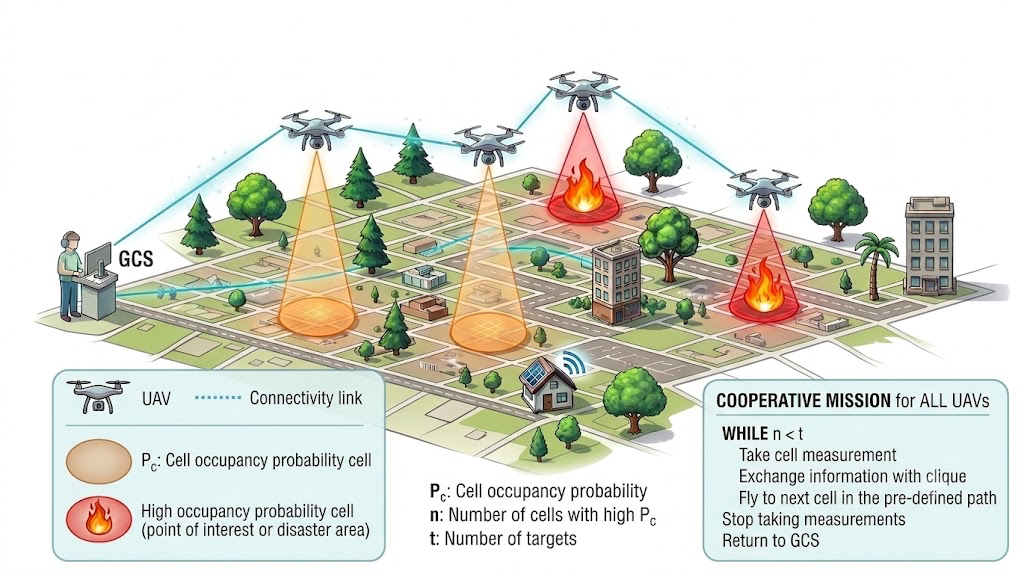
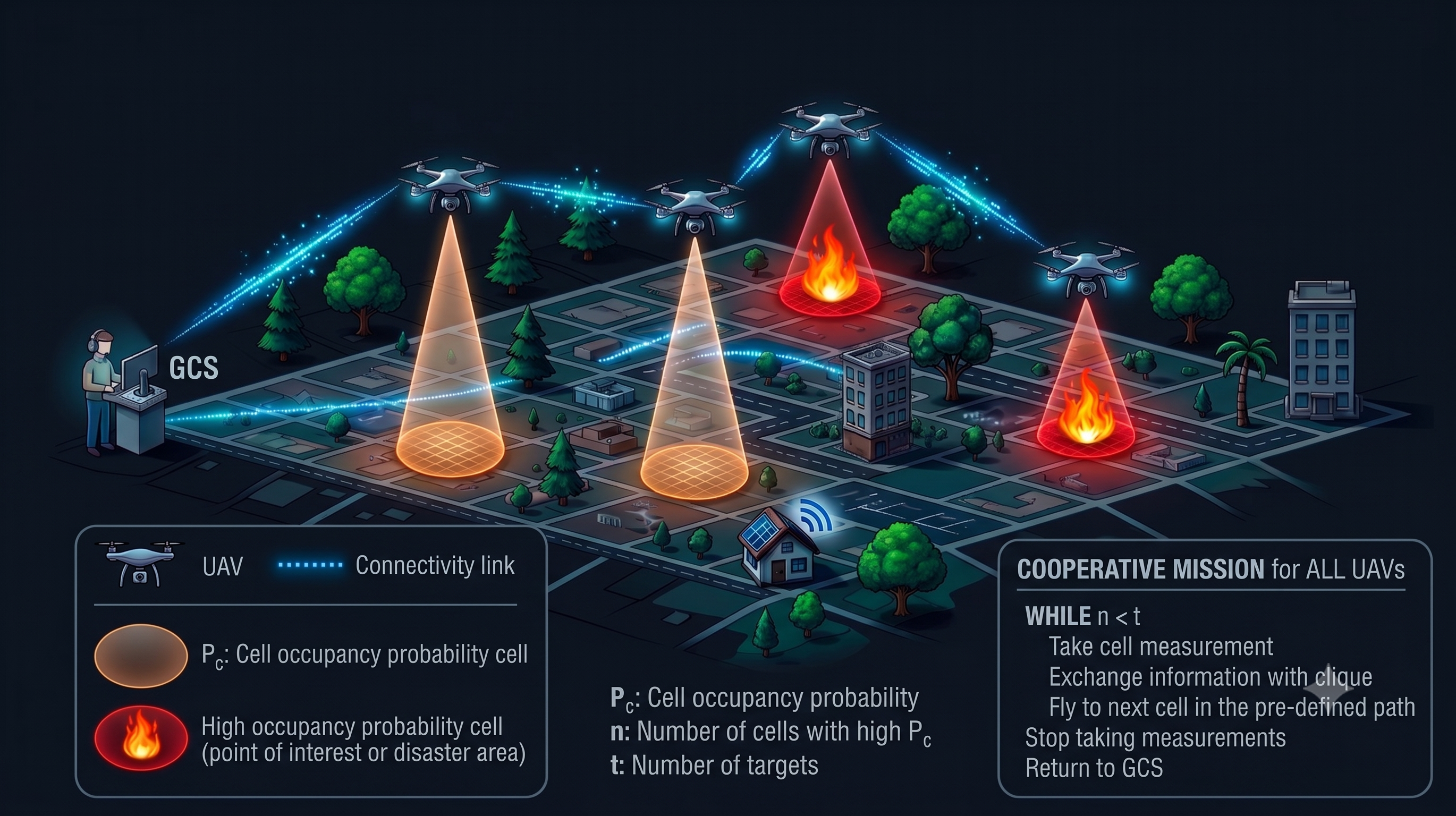
Three goals that pull against each other
Coordinating a swarm is a balancing act between conflicting requirements.[7] Push on one and the others give way:
Finding targets fast means spreading out and racing through the cells nobody has seen yet.
Sharing what each UAV senses means staying within multi-hop range of the GCS — which pulls the swarm back together.
Imperfect sensors miss targets, so high-uncertainty cells must be re-measured — and every revisit slows coverage.
No single path plan wins on all three. We therefore produce a Pareto front of trade-offs and let the operator choose the plan that best fits the mission at hand.[14]
Why optimise the time between visits?
Real sensors are imperfect: a single pass over a cell can miss a target with non-negligible probability. The remedy is redundancy — visit each cell several times and fuse the measurements.[3] But what really governs sensing quality is not how many times a cell is visited; it is how much time elapses between those visits. Long gaps let a cell's belief go stale and slow the swarm's convergence to a confident detection; shorter gaps keep every cell's information fresh and lift detection reliability — at the price of tighter, slower coverage.
Most prior work fixes the number of revisits or ignores revisit timing altogether.[8, 13] Treating the maximum mean time between visits as a first-class optimisation objective — next to coverage time and connectivity — is the core novelty this work adds to the joint coverage–connectivity problem.[14, 16] It is a subtle lever, but a decisive one for how well a search mission actually finds what it is looking for.
What this demo is built on
This interactive demo is the direct result of two publications from the underlying MSc thesis — a Vehicular Technology Conference paper[14] and an MSWiM paper[16] — adopting the sensing models of[3] and the information-sharing paradigm of[15].
- Two multi-objective formulations: one jointly optimising coverage time, connectivity to the GCS and UAV disconnectivity, the other adding cell revisit time.
- Custom genetic operators that drop into any genetic algorithm.
- Diverse Pareto fronts per scenario, so an operator can pick the solution that fits the mission.
- A benchmark of objective-optimal paths on cooperative search-and-inform time metrics.
References
- [1] D. Kalafat, “Statistical evaluation of Turkey earthquake data (1900–2015): A case study,” Eastern Anatolian Journal of Science, vol. 2, no. 1, pp. 14–36, 2016.
- [2] X. Ji, X. Wang, Y. Niu, and L. Shen, “Cooperative search by multiple unmanned aerial vehicles in a nonconvex environment,” Mathematical Problems in Engineering, vol. 2015, no. 1, p. 196730, 2015.
- [3] A. Khan, E. Yanmaz, and B. Rinner, “Information exchange and decision making in micro aerial vehicle networks for cooperative search,” IEEE Transactions on Control of Network Systems, vol. 2, no. 4, pp. 335–347, 2015.
- [4] S. Saha, A. E. Vasegaard, I. E. Nielsen, A. Hapka, and H. Budzisz, “UAVs path planning under a bi-objective optimization framework for smart cities,” Electronics, vol. 10, p. 1193, 2021.
- [5] H. V. Nguyen, H. Rezatofighi, B.-N. Vo, and D. C. Ranasinghe, “Multi-objective multi-agent planning for jointly discovering and tracking mobile objects,” in AAAI Conf. on Artificial Intelligence, 2019.
- [6] H. Ergezer and K. Leblebicioğlu, “Online path planning for unmanned aerial vehicles to maximize instantaneous information,” Intl. Journal of Advanced Robotic Systems, vol. 18, 2021.
- [7] E. Yanmaz, H. M. Balanji, and İ. Güven, “Dynamic multi-UAV path planning for multi-target search and connectivity,” IEEE Transactions on Vehicular Technology, vol. 73, no. 7, pp. 10516–10528, 2024.
- [8] Z. Liu, X. Gao, and X. Fu, “A cooperative search and coverage algorithm with controllable revisit and connectivity maintenance for multiple unmanned aerial vehicles,” Sensors, vol. 18, no. 5, p. 1472, 2018.
- [9] S. Kazemdehbashi and Y. Liu, “An exact coverage path planning algorithm for UAV-based search and rescue operations,” arXiv preprint arXiv:2405.11399, 2024.
- [10] P. Sujit and D. Ghose, “Search using multiple UAVs with flight time constraints,” IEEE Transactions on Aerospace and Electronic Systems, vol. 40, no. 2, pp. 491–509, 2004.
- [11] J. Zheng, M. Ding, L. Sun, and H. Liu, “Distributed stochastic algorithm based on enhanced genetic algorithm for path planning of multi-UAV cooperative area search,” IEEE Transactions on Intelligent Transportation Systems, vol. 24, no. 8, pp. 8290–8303, 2023.
- [12] W. Botes, “Grid-based coverage path planning for multiple UAVs in search and rescue applications,” PhD thesis, Stellenbosch University, 2023.
- [13] A. Wolek, S. Cheng, D. Goswami, and D. A. Paley, “Cooperative mapping and target search over an unknown occupancy graph using mutual information,” IEEE Robotics and Automation Letters, vol. 5, no. 2, pp. 1071–1078, 2020.
- [14] K. Kara and E. Yanmaz, “Joint optimization of connectivity, coverage, and revisit time in multi-UAV path planning,” in Proc. IEEE Vehicular Technology Conference (VTC), June 2025.This work
- [15] A. Khan, E. Yanmaz, and B. Rinner, “Information merging in multi-UAV cooperative search,” in IEEE International Conference on Robotics and Automation (ICRA), pp. 3122–3129, 2014.
- [16] K. Kara, İ. Güven, and E. Yanmaz, “Cooperative multi-target search with UAV swarms: Evolutionary vs. reinforcement learning strategies,” in Proc. International Conference on Modeling, Analysis and Simulation of Wireless and Mobile Systems (MSWiM), Oct. 2025.This work
Find the path that fits the mission.
Browse and analyse 20 search-and-rescue path-optimisation models, or compare them head-to-head across objectives and sensing time-metrics — with Pareto fronts, belief-merging analysis, and live mission playback.
Explore Missions
Pick a model to explore its parameter sweeps, trade-offs, merging strategies, and live mission animations.
- Parameter-effect analysis
- Pareto front & solution selection
- Belief-merging & mission playback
Optimize
Configure and run your own optimization, and watch the front take shape while the generations advance.
- SOO & MOO (NSGA-II / NSGA-III / MOEA/D)
- Weighted-sum with custom weights
- Live progress, then hand off to Analysis
Compare Models
Put models head-to-head across every objective and sensing time-metric — even objectives a model never optimised.
- Bar, line & table views
- Objective & time-metric comparison
- Cross-model, cross-parameter
Analyze a Run
Open one finished run — handed over from the optimizer, or uploaded as the JSON it exported — and dig through the front it produced.
- Upload an export, or arrive from Optimize
- Run summary & best objective values
- Pareto front, solution select & playback